
Economics makes more sense when you can see it in action.
Don’t just memorize economics. Investigate it.
Dollar Duo Economics is an app built around a simple idea: economic reasoning is learned by doing it, not by reading about it. Instead of a bank of quiz questions, Dollar Duo puts students inside investigations — they make a choice or a prediction, look at what happens next, and work out why.
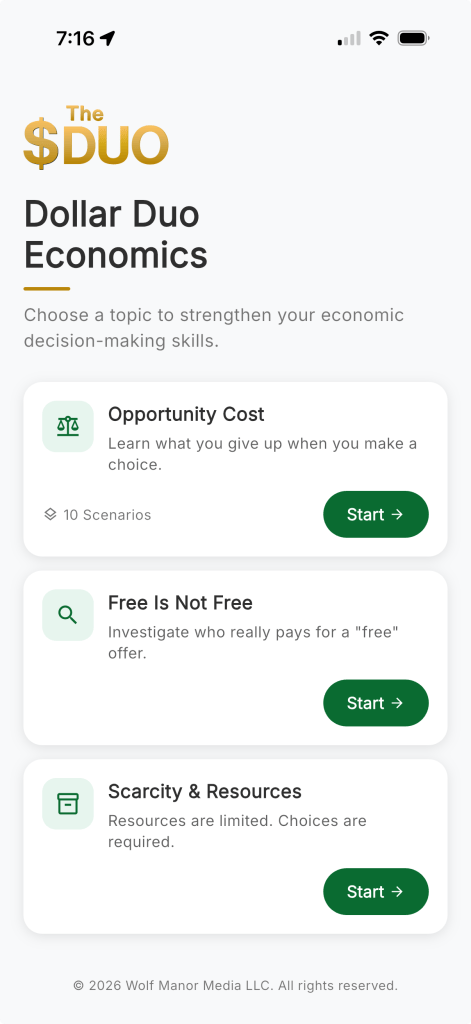
Try Dollar Duo Economics
Explore the app or watch selected learning examples
Choose → Investigate → Understand
Every Dollar Duo activity follows the same underlying arc, even though each topic uses its own approach to get there. Students choose or predict, investigate the evidence or consequences of that choice, and arrive at an explanation that corrects a misconception rather than just confirming an answer.
This is what makes Dollar Duo different from a typical quiz app — and it’s also what makes it useful preparation for AP Economics, where students need to apply economic concepts and reasoning to questions and scenarios.
Note: Opportunity Cost, Free Is Not Free, and Scarcity & Resources each use a different gameplay style suited to the concept they teach. The Choose → Investigate → Understand arc is the throughline, not a single fixed mechanic.
Opportunity Cost
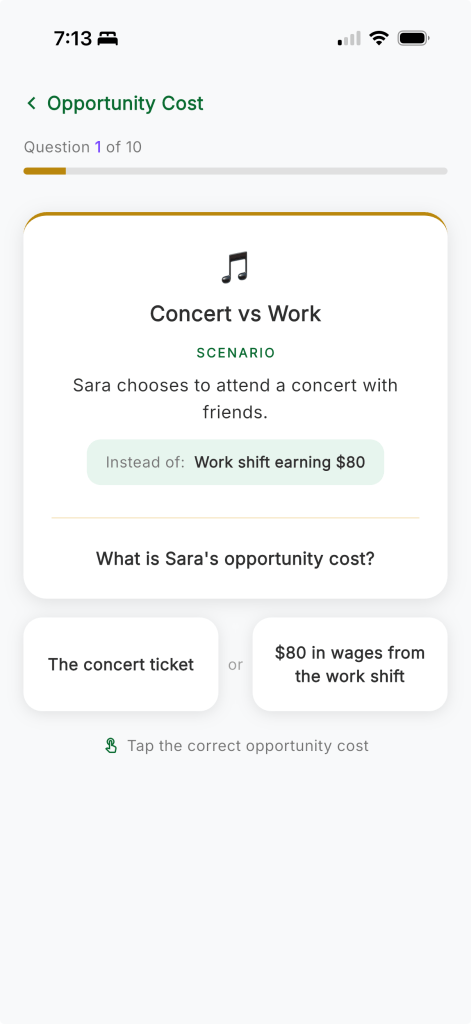
Opportunity cost is easy to describe imprecisely. Dollar Duo focuses on the idea economists actually use: identifying the next-best alternative forgone, not simply “what you give up.”
Students work through realistic decisions, sort out the opportunity cost from other costs and alternatives in play, and build the habit of asking “compared to what?”
The activity currently includes 10 scenarios, along with Quick Practice and AP Challenge modes.
Free Is Not Free
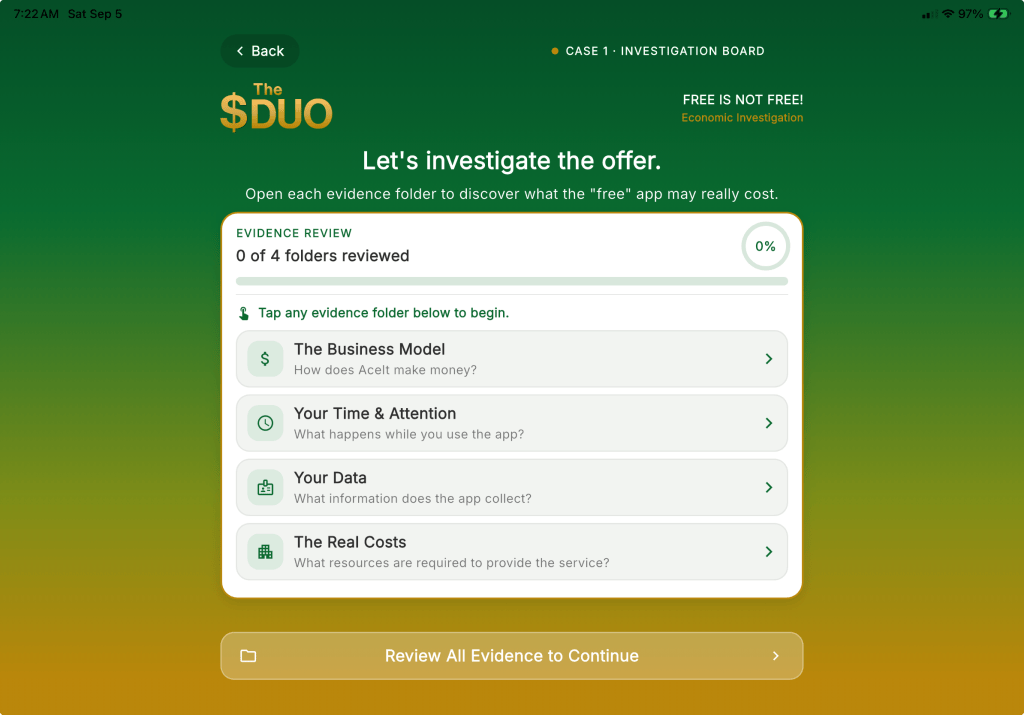
What does “free” actually mean? Free Is Not Free turns that question into an investigation. Students examine an offer, open evidence folders, and dig into the business model behind it — time and attention, data, and the real resources required to provide the service.
The point isn’t that free things are secretly a scam. It’s that something can be free to the user at the point of use while still requiring scarce resources to provide — resources whose costs are often borne by someone else. Students work out how a given offering is actually funded, and who ends up paying for it.
Scarcity & Resources
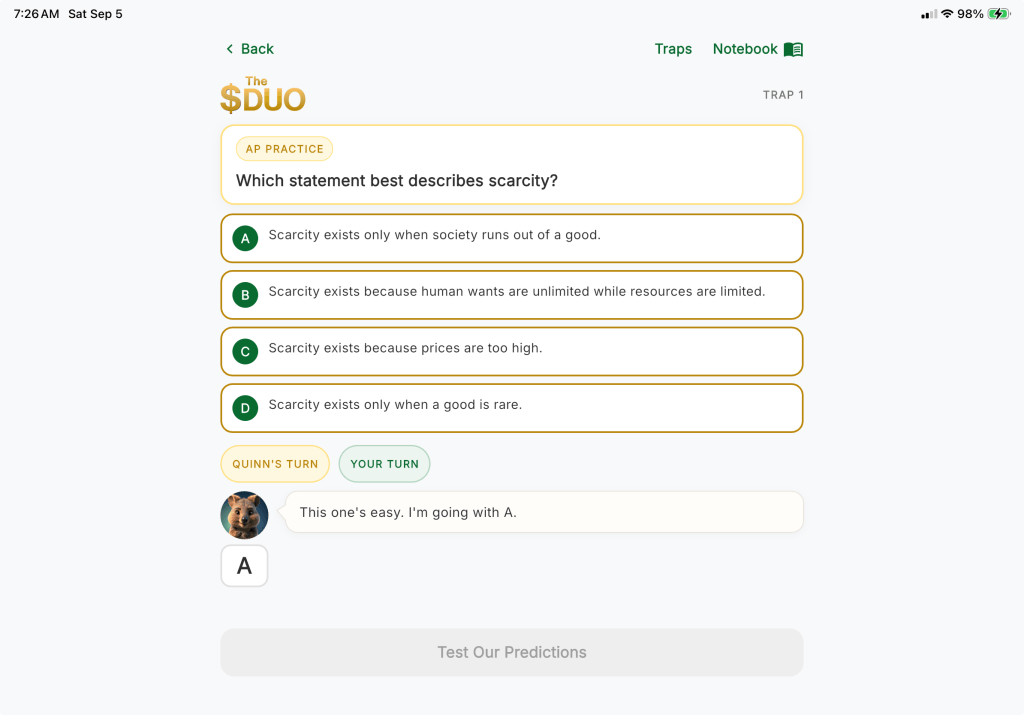
Quinn, a friendly quokka, is practicing for the AP Economics exam — and she needs a coach. Quinn starts out with plausible misconceptions about scarcity and resources, and it’s the student’s job to help her think more clearly.
Students make predictions, test ideas, examine evidence, correct Quinn’s misconceptions, and help her turn each correction into a memorable rule she can rely on later.
The Quinn Notebook
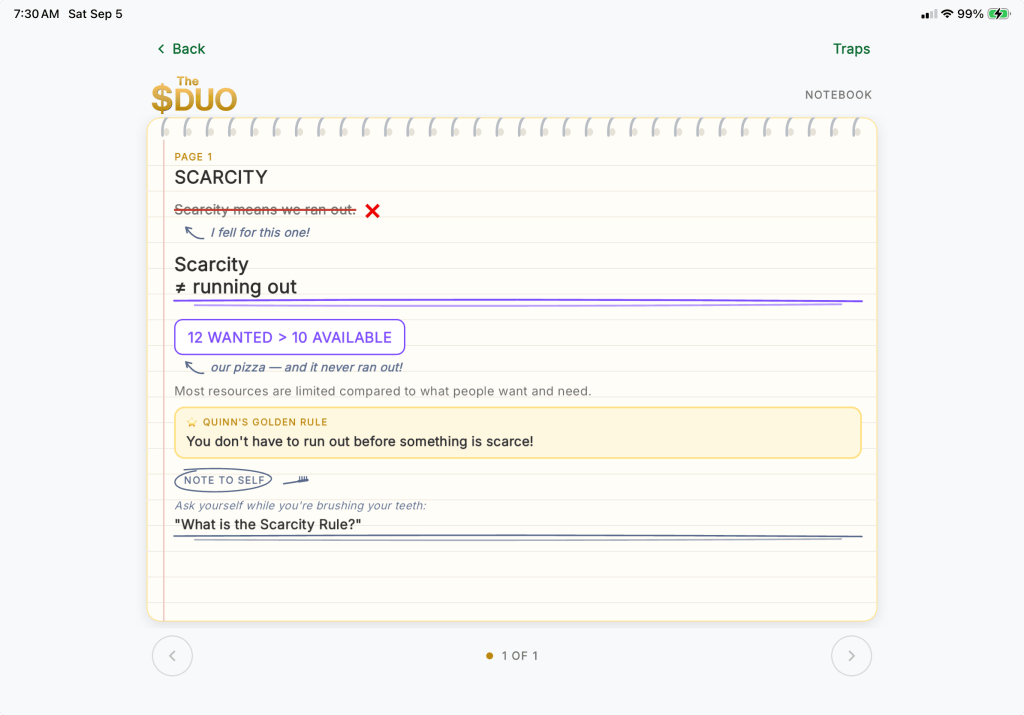
As students help Quinn correct her misconceptions, the Quinn Notebook captures what she has learned: the misconception she started with, the evidence that changed her thinking, and a memorable rule to carry forward.
Designed to look like a student’s working notebook — complete with underlines, corrections, arrows, and notes to self — it gives students a visual place to revisit the economic ideas they’ve uncovered.
Built for iPhone and iPad
Dollar Duo is designed for both iPhone and iPad, including iPad in landscape orientation — a deliberately supported layout, not an afterthought.
Interested in Dollar Duo?
Dollar Duo Economics is currently being tested on iPhone and iPad. Educators, students, and others interested in the project are welcome to get in touch.

